Task agents
Agents that research, draft, check and submit a piece of work, calling the tools each step needs. A refund agent, for example, reads the request, checks the order and the policy, drafts the refund and waits for a person to approve it.

AI agent development
Bluelupin builds AI agents that plan steps, call your APIs and databases, draft documents and hand work to people for approval. For larger workflows we build multi-agent systems, where specialist agents work under a supervisor agent. Every agent runs with scoped access, approval gates for risky actions, step-by-step logs and a way to stop it.
An AI agent is software that uses a language model to decide its next step, call tools such as your APIs or databases, and check its own progress toward a goal. A chatbot answers questions. An agent also acts, within limits you set.
| You need | Use |
|---|---|
| Fixed steps you can draw as a flowchart, with AI for one or two of them | AI workflow automation |
| A system that decides its own steps and uses several tools | AI agent development (this page) |
| Customers or citizens chatting or calling in | Conversational AI |
| Staff asking questions of your own documents | RAG development |
If the steps are fixed and known in advance, see AI workflow automation. If the system has to choose its own steps and tools, see AI agent development.
Examples of what we can build.
Agents that research, draft, check and submit a piece of work, calling the tools each step needs. A refund agent, for example, reads the request, checks the order and the policy, drafts the refund and waits for a person to approve it.
Specialist agents for research, drafting and checking, working under a supervisor agent that hands off work and keeps shared state. One agent is the right start for most projects. A team of agents is worth the extra cost and testing when the steps need different skills and are easier to test separately.
An approval and exception agent in Slack or Microsoft Teams, a task assigner that routes tickets by context and priority, and a multi-agent system for operations monitoring and reporting.
Each agent gets a short list of tools: REST and GraphQL APIs, database queries and document generation. Every tool runs with its own scoped credentials, and every call is logged. Agents can also start an existing n8n workflow, call a webhook or hand a step to an RPA bot (Business Process Automation) for screens that have no API.
For integration work without AI, see our API and integration services.
We design the controls before we build the agent.
Governance and responsible AI are built into every Bluelupin build.
We pick one workflow, agree how success will be measured and check the systems the agent will use. This is the strategy and readiness phase of every Bluelupin build.
A working agent on test data, with traces and a set of test cases for the decisions it makes.
A pilot with approval gates switched on, then production once the agent meets the agreed measures.
Rollout and training for the teams who use the system can be included. How we roll out.
Our AI model monitoring and optimization service can run it after launch. Feedback improves prompts, tools and test cases.
How long it takes: A first prototype can be ready in 1 to 2 weeks. Pilots usually take 4 to 8 weeks, and production systems usually take 3 to 6 months.
We pick the model for each agent by accuracy, cost, speed and data residency needs. Bluelupin is an OpenAI partner.
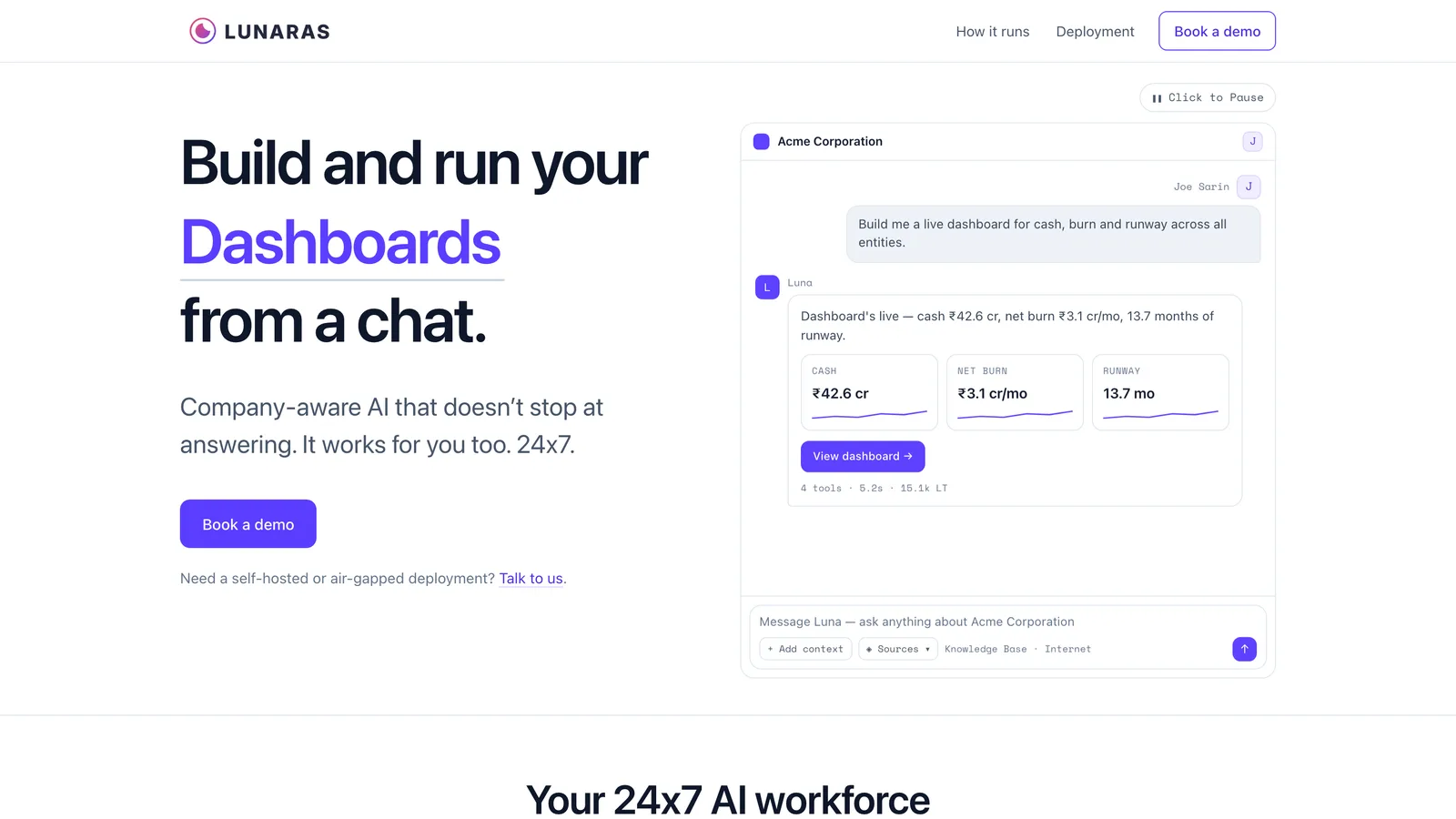

We designed and built Lunaras, a company-aware AI platform. It connects to the systems a company already runs and keeps its own records alongside them, so the assistant that answers a question can also run the next step. Teams use it to build and run data analysis, dashboards, reports, presentations, workflows and agents from a chat. Lunaras runs in India, with Mumbai as its primary region, or wherever a client's data has to stay, and also offers hybrid and on-premises deployment, including air-gapped installs. Lunaras is in beta.
Common questions about AI agent development.
A chatbot answers questions. An AI agent also acts: it calls tools, updates records and passes work to people or other systems, within limits you set. Many projects use both, with a chatbot talking to customers and an agent doing the work behind it.
When a workflow has distinct specialist steps, such as research, drafting and checking, that are easier to build and test separately. One agent is the right starting point for most projects. A multi-agent system adds cost and testing, so we use it only when the steps need it.
Each agent can only take the actions on its allowlist, within spend and volume limits. Actions that move money or change citizen records wait for a person to approve them. We test agents in a sandbox first, log every step and give you a control that stops an agent at once.
Yes. Agents can start n8n workflows, call webhooks and hand steps to RPA bots for screens that have no API. Your existing automation keeps running, and the agent handles the steps that need judgment.
A first prototype can be ready in 1 to 2 weeks. Pilots usually take 4 to 8 weeks, and production systems usually take 3 to 6 months. The time depends on how many systems we connect, how ready your data is and how many review and approval steps the work needs.
Cost depends on the number of tools and systems the agent uses, the approval steps, how ready your data is, model usage, how much testing its decisions need, and monitoring after launch. We scope these with you before the build.
You do. Once the project is paid for, you own the code, prompts, evaluation sets and configuration we build for you. The underlying AI models stay with their providers, such as OpenAI or Anthropic.
Send us the workflow you want an agent to handle, the systems it would use and who approves what, and we will help you plan the first step. Response within one business day.
Talk to our AI teamOr email sales@bluelupin.com or call +91 99100 24224


