 Bluelupin is an OpenAI partner.
AI agent development
Agents that use tools, plan steps and coordinate with each other in your workflows, with human oversight.


AI Solutions
Bluelupin is an OpenAI partner.Bluelupin is an AI development company in India, with teams in Noida and Bengaluru. We plan, build and run AI agents, RAG search and knowledge assistants, chatbots, document processing and workflow automation, and connect them to the ERPs, CRMs, helpdesks and data systems you already use. We choose OpenAI, Anthropic or open-source models for each project.
We design, build, and run AI solutions on OpenAI models and choose other models when a project needs them.
What we build
Agents that use tools, plan steps and coordinate with each other in your workflows, with human oversight.
Search and assistants that answer from your wikis, SharePoint, tickets, databases and internal documents, with cited answers and role-aware access, inside Slack, Microsoft Teams or your portal.
AI-powered OCR, classification, extraction and validation for high-volume document work.
Chatbots and assistants for customer support, sales and citizen services, on web chat, mobile apps and Microsoft Teams.
Routing, classification, approvals and orchestration across ERP, CRM and custom applications.
Not sure where AI fits yet? Every build starts with AI strategy and readiness.
How we start
If you are planning AI transformation across several teams, or are not yet sure where AI should go first, every Bluelupin build begins with a short strategy and readiness phase. It is the first part of the project, so the use case we agree on is the one we go on to build.
We run workshops with your business and technology leaders to agree your goals, constraints, risk appetite and how success will be measured. We then score candidate use cases on business value, feasibility and data readiness, map the dependencies between them, and turn them into a shortlist of the use cases to build first, with clear criteria for build or buy decisions and model choices.
We review your data quality, platforms, skills, security and governance, and test the top use cases against data availability, integration complexity and regulatory fit. The result is a data readiness check that lists the gaps and the steps to close the critical ones before the build continues.
For generative AI work, this phase covers use-case design, the choice of model and platform (for example OpenAI, Anthropic, AWS Bedrock or Azure OpenAI), and a plan for a controlled pilot with evaluation datasets and a security review. We also plan for running costs with token budgets, model routing and caching. This is the generative AI consulting we do at the start of each build, and the pilot becomes the first release.
The phase usually takes one to two weeks and is priced inside the build. It is never sold on its own.
Next step: the phase leads straight into step 2 of How an AI project works.
Use cases
Examples of what we can build.
Integration
Our AI integration services connect AI to ERPs, CRMs, helpdesks, data warehouses and custom applications through APIs, webhooks and event-driven pipelines, so AI adds to your workflows and your core systems stay in place.
Agents run inside your governed environments and connect to the systems your teams already use.
Delivery
We work in four steps, then help you run what we build.
Joint workshops to identify high-impact automation and agentic opportunities, map available data sources, and agree how success will be measured. This is the strategy and readiness phase described above.
Rapid prototyping using n8n workflows, OpenAI and LangChain agents, and mock data to validate user journeys within 1 to 2 weeks.
Hardened implementation with secure APIs, monitoring, and analytics dashboards for visibility across departments.
Rollout and training are part of every build. Before launch, we map who the new system affects and how their work changes. We then roll it out in waves, with role-based training, playbooks and office hours for the people who use it, and feedback channels at every stage. Adoption dashboards show usage and satisfaction by team, so problems are fixed before the next wave.
Once the system is live, our AI team can monitor it, watch for drift, run evaluations and tune it.
How long it takes: A first prototype can be ready in 1 to 2 weeks. Pilots usually take 4 to 8 weeks, and production systems with integrations, monitoring and governance usually take 3 to 6 months, depending on data readiness, scope and compliance needs.
Further reading: Discovery to hypercare: a delivery shape for AI programs
Getting started
Governance
Governance, security and responsible AI are built into every Bluelupin build, from the first workshop to the system running in production. They are part of how we design, build and run each project, and we do not sell them as a separate review.
Deployments can include:
Further reading: Approval gates for AI agents that touch money or citizens
Who it's for
We designed and built IndiaAI, India's national AI portal, with MeitY and NeGD. For government projects we design for least-privilege access, encryption in transit and at rest, audit logging and deployment on approved cloud regions.
We co-deliver through embedded squads that share architecture decisions, runbooks and knowledge transfer, so your team owns the platform.
Dedicated squads embed with your product and engineering leadership, from roadmap delivery to platform modernization and AI feature development.
Start with a quick pilot to test one use case before a larger build (see Two ways to start above).
Proof
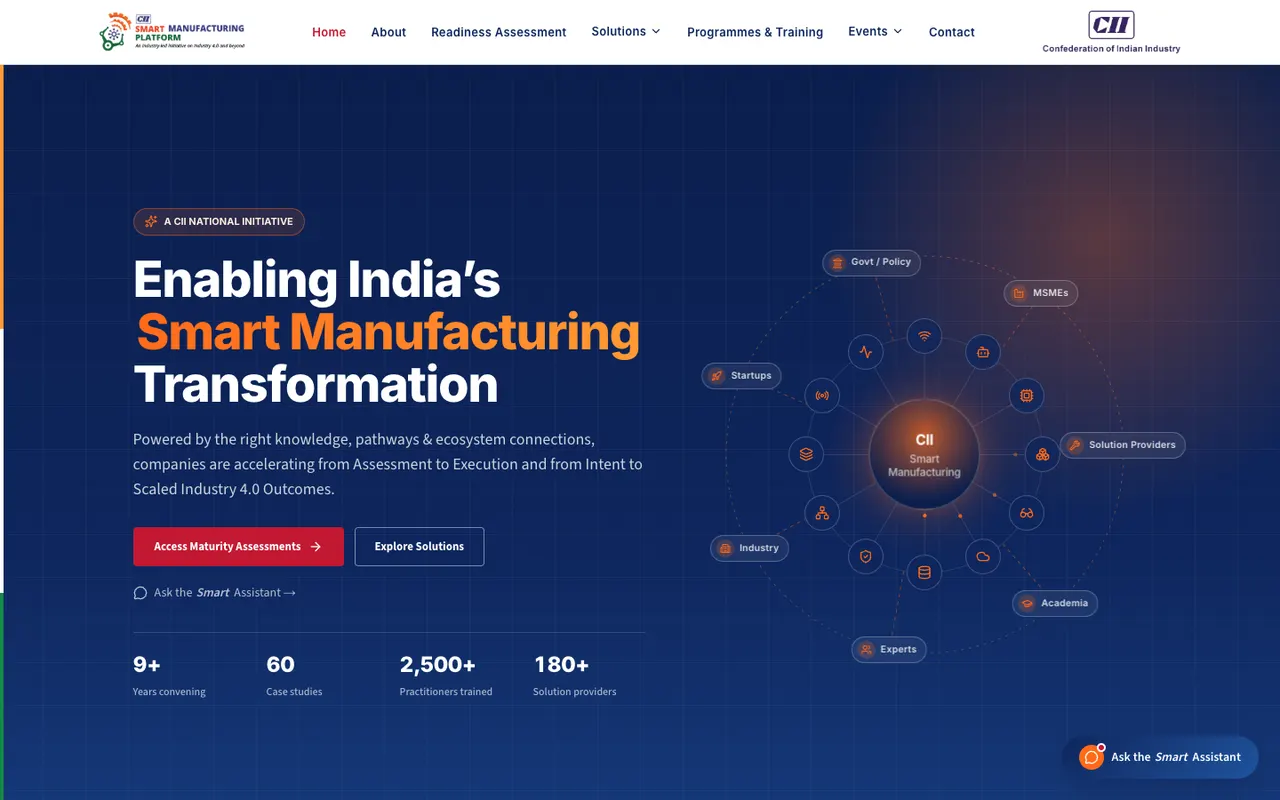
We built the CII Smart Manufacturing Platform, a national portal that helps MSMEs with maturity assessments, solution discovery, programmes and events, including the AI assistant that guides MSMEs through the platform and its programmes.
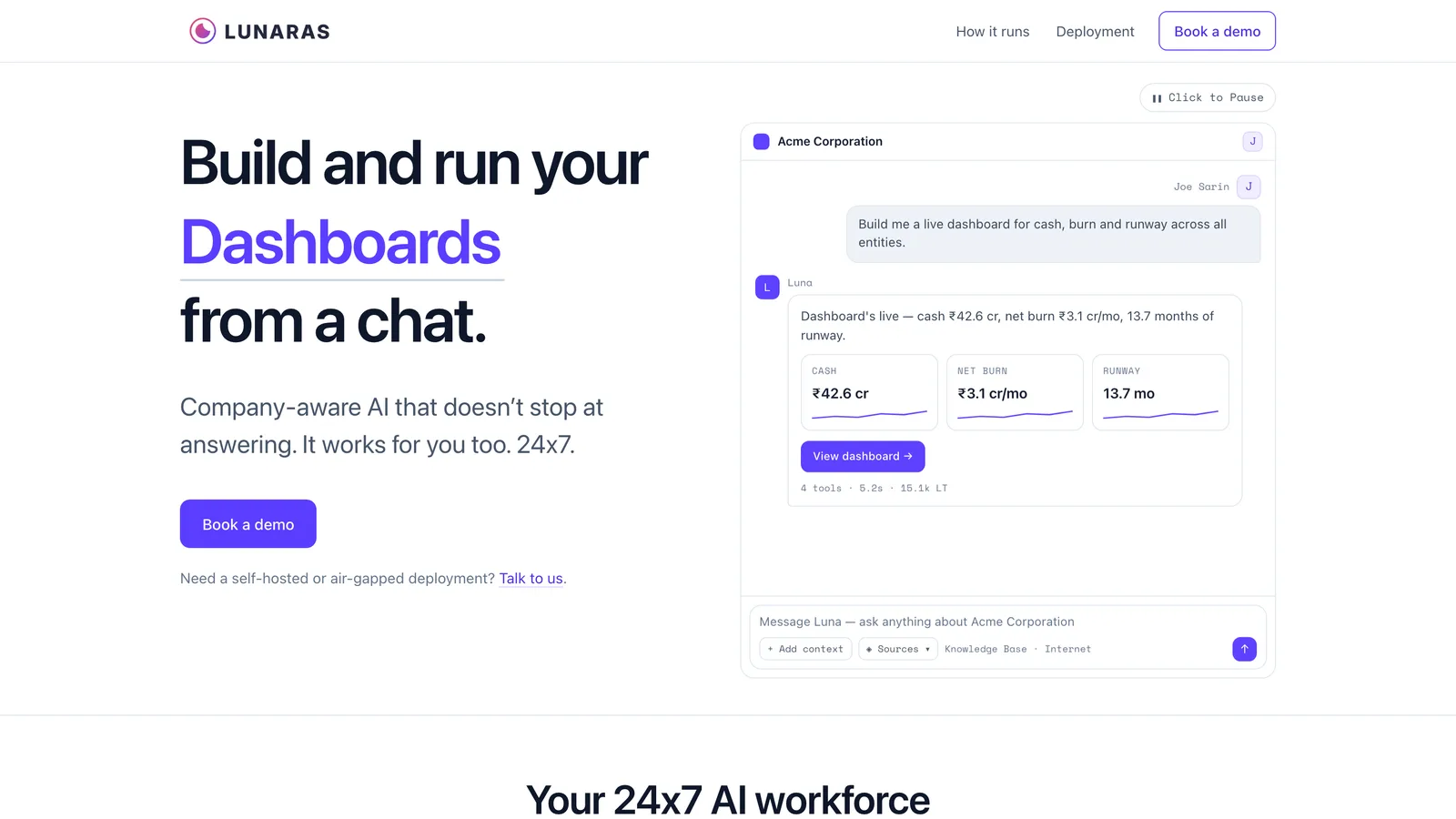

We designed and built Lunaras, a company-aware AI platform. It connects to the systems a company already runs and keeps its own records alongside them, so the assistant that answers a question can also run the next step. Teams use it to build and run data analysis, dashboards, reports, presentations, workflows and agents from a chat. Lunaras runs in India, with Mumbai as its primary region, or wherever a client's data has to stay, and also offers hybrid and on-premises deployment, including air-gapped installs. Lunaras is in beta.
Technology
We pick the model for each project based on accuracy, cost, speed and data residency needs, and we design to avoid vendor lock-in where possible. We build AI systems on a modern, secure, and composable stack that combines open-source and commercial tools.
Questions
Common questions about our AI development services.
Bluelupin designs, builds and runs AI agents and copilots, RAG search and knowledge assistants, chatbots, intelligent document processing and AI workflow automation, and connects them to your existing ERP, CRM and internal tools.
Yes. We connect AI to ERPs, CRMs, helpdesks, data warehouses and custom applications through APIs, webhooks and event-driven pipelines. Systems we work with include Zoho, Salesforce, HubSpot, Odoo, SAP, ERPNext, Slack, Microsoft Teams, BigQuery and Redshift. Your core systems stay in place.
We pick the model for each project based on accuracy, cost, speed and data residency needs. We work with OpenAI GPT models, Anthropic Claude, Meta Llama and other open-source models, and we design to avoid vendor lock-in where possible. Bluelupin is an OpenAI partner.
Yes. For quick pilots we use n8n workflows with ready connectors for chat, CRM, ERP and analytics. We prototype with n8n, OpenAI or LangChain agents and mock data to test user journeys before we build the full system.
We build in role-based access, data isolation, encryption, audit logging and guardrails on model outputs, and we use secure API patterns. Each system is designed to fit your identity and data governance policies.
We test models with evaluation frameworks before and after launch, add guardrails on outputs and keep a person in the loop to review accuracy. Knowledge systems built with RAG answer with citations to your own documents.
Yes. Bluelupin designed and built IndiaAI, India's national AI portal, with MeitY and NeGD. For government projects we design for least-privilege access, encryption in transit and at rest, audit logging and deployment on approved cloud regions.
Data residency is one of the factors we use to choose models and hosting, and we deploy on approved cloud regions that match your security policies.
We agree success measures before we build, such as handling time, automation rate, accuracy, cost savings or revenue impact. Dashboards and evaluations then track the system in production.
Yes. Every project starts with a short strategy and readiness phase: we agree the first use case, check your data and systems, and plan a pilot. That phase leads straight into the build.
No. Strategy, readiness, governance and rollout are phases of every Bluelupin build. Each project starts with a strategy and readiness phase, and governance and responsible AI controls are built into the system we deliver and run.
Yes, as part of every build. On every project we agree who owns and approves each AI system, use tiered review for high-risk use cases, keep audit logs and a record of models and versions, set approvals by role, put guardrails on what each AI agent can do, and test for accuracy and safety before and after launch.
Yes. Our AI Model Monitoring and Optimization service covers monitoring, drift detection, evaluation pipelines and optimization. We can also take over existing LLM, RAG and ML systems after a technical assessment and knowledge transfer.
Yes. We co-deliver through embedded squads and share architecture decisions, runbooks and knowledge transfer so your team owns the platform.
A first prototype can be ready in 1 to 2 weeks. Pilots usually take 4 to 8 weeks, and production systems with integrations, monitoring and governance usually take 3 to 6 months, depending on data readiness, scope and compliance needs.
The cost depends on scope. The main drivers are the number of use cases and systems we connect, how ready your data is, the approval and review steps, how much testing the system needs, model usage, and the monitoring and support it needs after launch. We can talk through these for your project on a call.
You do. Once the project is paid for, you own the code, prompts, evaluation sets and configuration we build for you. The underlying AI models stay with their providers, such as OpenAI or Anthropic.
Next step
Tell us what you want to automate, and our AI team will help you plan the first step. Response within one business day.
Or email sales@bluelupin.com or call +91 99100 24224


